A voltage-controlled amplifier (VCA) is a module that varies the amplitude of a signal based on a control voltage. The signal can be audio or another control voltage.
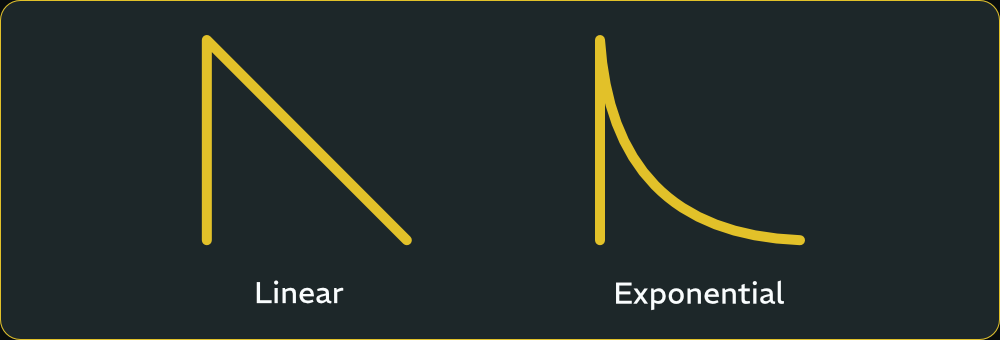
Most VCAs are linear, meaning the output level is directly proportional to the control voltage. A control voltage at half its maximum gives half the signal level. Exponential VCAs respond in decibels per volt, which is closer to how we hear loudness. On a linear VCA, a linear envelope tends to sound abrupt, with big changes in loudness early on and little change later. The same envelope on an exponential VCA sounds more even from start to finish. The chart below compares the two responses.
For modulating CV, linear VCAs are the usual choice because the result is an exact, level-controlled copy of the incoming signal. For example, to control the level of a sine wave LFO with CV and keep its sine shape, use a linear VCA.
Many envelope generators can be set anywhere between linear and exponential shapes, so a linear VCA is often all you need. Pairing an exponential envelope with an exponential VCA applies the curve twice, which makes the response much steeper.