
The Piston Honda MkIII has a reputation for being divisive. People tend to either love it or bounce off it hard. In my experience, that reaction often has less to do with the oscillator itself and more to do with how the default wavetable banks are organized.
I have spent a lot of time with the stock tables. There are tons of kick-ass waveforms for you to mess with. What is missing is a clear sense of structure.
The default Z-banks
Z1: Classic Waveforms 1 (traditional)
This bank is full of useful, mostly classic shapes. The issue is ordering. Adjacent waves often have little perceptual or harmonic relationship, which makes scanning feel arbitrary rather than intentional.
Z2: Lucifer Additive (Scott Jaeger)
This is the standout. It is the only stock wavetable that feels thoughtfully structured across the grid. There is a clear sense of progression, and it rewards both manual and CV-driven navigation. It also sounds dope as fuck. This table alone shows how effective the Piston Honda MkIII can be when the wavetable itself flows logically.
Z3: Classic Waveforms 2 (traditional)
Conceptually similar to Z1, but less focused. It feels like a junk drawer of waveforms. There are useful shapes in here, but they are harder to find and harder to move between in a meaningful way.
Z4: LFSR Vectors (Scott Jaeger)
These tables lean into Atari-like digital noise and glitchy textures. They are fun and distinctive, especially for harsher material. That said, their usefulness feels narrower. They might make more sense if the Piston Honda MkIII leaned further into LFO-rate or modulation-oriented roles.
Z5 to Z8 (Radek Rudnicki, Joey Blush, Rodent, Surachai Sutthisasanakul)
These banks may contain interesting individual waveforms, but as collections they lack a clear organizing principle. There is no obvious spectral progression, harmonic logic, or morphing intent. They feel more like random assortments than tools designed for deliberate traversal.
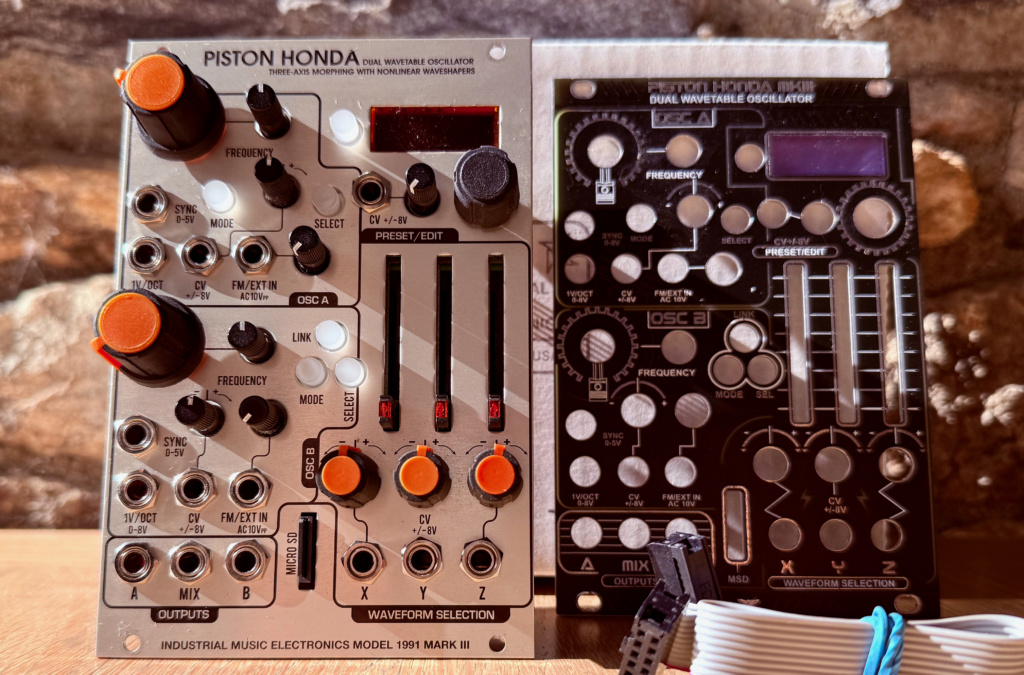
Where the frustration comes from
With the Piston Honda MkIII, much of the experience is shaped by how the wavetable behaves when scanned or modulated. Moving through a table is not an ancillary feature; it is central to how sound is shaped on the module. When adjacent waveforms do not relate to one another in a meaningful way, that movement becomes harder to use musically.
Most of the factory tables do not encourage exploration through movement, which limits how effective they are when driven by CV.
In a wavetable oscillator where scanning, morphing, and CV-driven navigation are core behaviors, organization matters. Without it, the instrument can feel chaotic, not because it inherently is, but because the material it ships with does not guide you toward coherent motion.
If you dislike the Piston Honda MkIII, it is worth asking whether you actually dislike the oscillator. You may just dislike the wavetables it comes with.
I spent a bit of time working on a waveset for the PH MKIII available here for download. here is what is on it:
Z1: Classic waves morphing
Z2: Bass fundamentals
Z3: Quantize-X FM-Y
Z4: Vocal formants
Z5: Lucifer Additive – Scott Jaeger
Z6: Harmonic sweep
Z7: Bitnoise
Z8: Supersaw

Curious how others feel about the stock tables versus custom ones. If the Piston Honda MkIII clicked for you or never did, leave a comment and say why.




Great write-up and wavetable share! I considered the Piston Honda Mkiii, along with the SynthTech e350, but ended up with VhikkX as my wavetable oscillator. In that module, everything is so well organized, it’s nothing but sweet spots!
Very timely article! I’ve been working with the PHmk3 for the past few weeks. So far I’ve not really been able to coax impressive results out of it. I see that it’s the favoriate oscillator of many people, so I’m assuming the problem is me — I’m not modulating it in a good way.
Thanks for the wavetable pack. I’ll be exploring it starting this evening! Do you have any additonal tips for working with these wavetables? Such as XX “works well in dual mode slightly detuned” or something like that. How are you usually modulating the three axises — like with envelopes or LFOs more discrete, step seq values? Maybe I’m a noob — I don’t really feel like I understand how we are expected to use this thing.
Thanks for posting the wavetables. I look forward to trying them out.
Thanks for putting these together!